
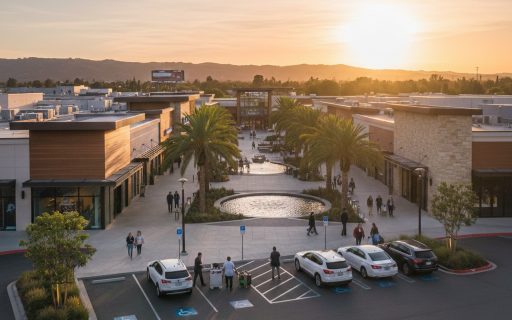
Retail expansion is still very much alive—but the playbook has changed.
Open-air centers are seeing continued demand in large part because they support omnichannel behaviors like pickups and returns, which has reshaped where (and how) many retailers grow. At the same time, retailers are operating in a market where store openings and closures are happening side-by-side—making “good real estate” more competitive, and speed-to-decision more important.
That’s the context behind this case study: a legacy specialty retailer needed to accelerate growth in new markets—fast—without lowering the bar on site quality.
The client: a legacy specialty retailer expanding with urgency
The client is a specialty retailer with 75+ years of heritage and a 1,200+ store footprint. In 2025, they set aggressive growth goals to expand into new markets while optimizing existing ones. Their growth focus included:
- 60+ new stores annually
- Emphasis on mid-sized and underserved markets (varies by state)
- Footwear, apparel, and accessories
- Continued investment in e-commerce and omnichannel, including BOPIS
This omnichannel detail matters: as BOPIS and “store-supported e-commerce” become standard, site requirements shift (access, parking flow, co-tenancy, convenience, and trade area dynamics). Deloitte notes how retailers have made omnichannel services like pickup/curbside a core expectation—raising the operational stakes of each location choice. If you're updating your criteria, 5 Pillars of Site Selection is a quick way to align stakeholders on what matters most.
The challenge: speed and standards
The mandate wasn’t just growth—it was growth at quality:
- Deliver 60+ deals, including many same-year openings
- Maintain consistent site standards across diverse markets (space configuration/size, co-tenancy fit, competitive context)
In practice, that’s hard for many internal teams to do alone. High-volume pipelines break when market coverage is uneven, evaluation criteria vary by region, or site decisions aren’t backed by consistent, comparable analysis.
The approach: pairing market coverage with embedded intelligence
To support the pace and the bar, CRE 360 deployed a repeatable model built for multi-market expansion:
- High-volume market sourcing across multiple geographies at once
- Data-driven evaluation (demographics, competitive mapping, and research support embedded into the transaction workflow)
- No geographic restrictions—coverage aligned to where growth targets required
- Execution discipline from opportunity identification through negotiation/LOI
This mirrors how leading retail teams increasingly operate: stores remain central to omnichannel strategy, but the decision process is more analytical and repeatable than it was even a few years ago.
Results: 13 LOIs in 9 months
The outcome speaks to both pipeline velocity and execution reliability:
- 13 LOIs secured in just 9 months
- CRE 360 recognized among the top producing partners in the client’s national network
What this means for expansion leaders: 5 practical takeaways
If you’re trying to scale store growth in 2026 planning cycles, this case highlights a few truths that tend to separate smooth expansion from stalled expansion:
- Market coverage is a strategy, not a staffing problem
If your targets span mid-sized/underserved markets, you need sourcing that’s built for breadth without losing consistency. - Speed requires standardization
Faster deal flow usually comes from repeatable screening criteria (trade area logic, co-tenancy rules, competitive thresholds)—not just “more leads.” - Data only helps if it’s embedded in the workflow
Research that sits outside transactions slows teams down. Embedded analysis speeds decisions because it arrives in the format decision-makers need. - Omnichannel changes the site filter
BOPIS expectations raise the floor on access, convenience, and operating fit—especially in open-air centers where pickup/returns are easier to execute. - Execution is the multiplier
Many teams can find “interesting sites.” Fewer can consistently convert them into LOIs under real time pressure.
Where CRE 360 fits
For growing retailers, CRE 360’s advantage is straightforward: we pair analytics with execution—so expansion teams can scale across markets without sacrificing decision quality.




Watch
Data-Driven Confidence in Scarce Markets
Ready to Elevate Your Strategy?
Schedule a consultation today to discuss your project and see how we can help you achieve your goals.