
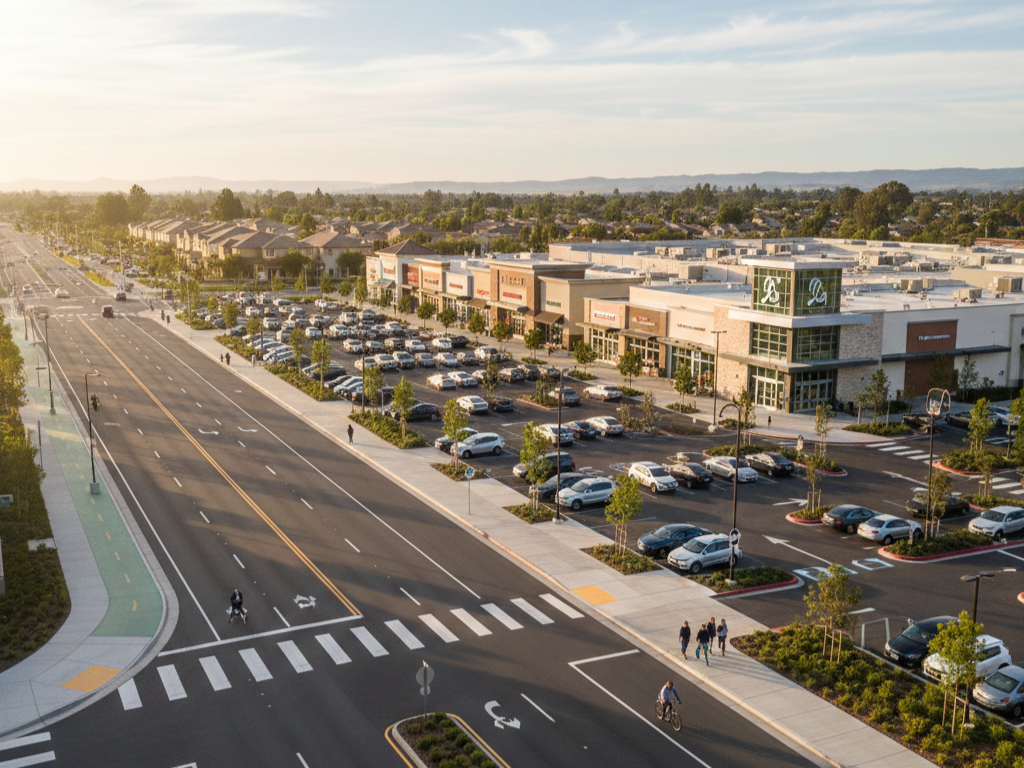
Your market list probably hasn’t gotten shorter. Your “approved site” list has.
That’s the practical reality of 2026: the constraint is usable space at workable economics. New supply remains limited and vacancy is still extremely tight, which keeps the best opportunities competitive and approval standards high. (Cushman & Wakefield)
Why the local-draw view is the unit of competition now
The metro name doesn’t decide performance — the immediate area around the site does.
In practice, that’s where customers combine:
- Errands (grocery, pharmacy, value/discount)
- Services (fitness, medical, personal care)
- Food (quick-service + casual dining)
- Selective discretionary (specialty, gifting, seasonal)
This matters more when the market is tight and a growing share of “opportunities” are second-generation space.
- Cushman & Wakefield notes vacancy around 5.7% and highlights limited new supply plus increased backfilling of second-gen spaces. (Cushman & Wakefield)
- JLL estimates announced closures could free up about 140M SF, which reinforces a key reality: more options may appear, but the usable options in the right immediate area are still limited. (JLL)
- CBRE’s outlook adds context: tenants are more cautious and decision cycles are stretching, which makes “prove it fast” locations more valuable. (CBRE)
So the core question shifts from “Is this a good market?” to: “Does this location’s local draw produce the trips we need — and does the deal still work after reality hits?”
What’s actually diverging in 2026
The story isn’t “one format wins.” It’s that quality and function matter more, and the gap between “works” and “doesn’t” keeps widening.
1) Scarcity raises the standard
When vacancy is this low, the best sites get bid up — and the sites that look good on paper still get rejected if they can’t clearly support sales, staffing, buildout, and timing. (Cushman & Wakefield)
2) Closures create space, but not always real choices
Closures can bring inventory back, but second-gen boxes often come with layout constraints, capex needs, or execution risk. That’s why “more listings” doesn’t automatically mean “more viable options” in the same local draw. (JLL)
3) Trip mission and seasonality change the winner list
Placer.ai’s 2025 shopping center trends show that performance varies by asset type and season — a reminder that why people go somewhere (quick errand vs browse vs occasion) is a major variable. (Placer)
The “Winning Location” quick read
1) Access is effortless
Clean turns, obvious entry, fast parking, low hassle at peak. If customers have to think, you’ll feel it in conversion.
2) The area supports one-trip behavior
The best locations aren’t just “near grocery.” They support the same trip: grocery/value + services + food that people already combine without extra turns or extra parking lots.
3) Weekly demand is the backbone
Look for frequency drivers (grocery, discount, off-price, essential services). Discretionary can thrive — but it shouldn’t be the only reason people come.
4) Comparable alternatives are scarce
“Vacancy exists” doesn’t mean “options exist.” In tight conditions, what matters is how many comparable sites exist within the same 5–10 minute drive. (Cushman & Wakefield)
5) The economics still work after reality hits
Underwrite with real assumptions: buildout/TI, timeline, ramp, staffing. Prime locations can command more, but they need to pencil without hero assumptions.
6) The trip mission fits your concept
Not every “busy” area works for every brand. Quick-errand zones, service-led nodes, and browse/occasion destinations favor different formats — and traffic patterns can diverge by type and season. (Placer)
How retailers use the local-draw lens to shorten approvals
1) Start with the 5–10 minute drive, not the address
Rank the immediate areas you want first, then tour only the best sites inside them.
2) Write a one-page “local draw” memo
Make it easy for internal reviewers:
- Access notes (peak-hour reality)
- Trip mission (why people come here)
- What stacks naturally (errands + services + food)
- Real alternatives (and why they’re not equivalent)
3) Get execution clarity early
Second-gen space can be compelling, but ambiguity kills deals. CBRE notes longer decision-making as tenants become more cautious; clarity on delivery condition, scope, and timeline keeps deals moving. (CBRE)
How landlords become “easy to approve” in 2026
In a tight market, the pitch that wins velocity is certainty.
Build a simple Site Proof Pack (one pager + appendix) that a tenant can forward internally:
- Drive-time map: 3/5/10-minute rings + access highlights
- Retail corridor context (normal meaning): the commercial strip(s) that drive visibility and daily trips
- “One trip” story: why errands + services + food combine here
- Competitive set: 3–6 realistic alternatives with quick notes
- Space reality: what’s required to make the box usable (and who covers what)
- Timeline + risk: permitting notes, delivery condition, known constraints
- Terms snapshot: deal structure that reduces execution risk
This matters because even if closures add inventory, the locations with the strongest repeat-trip patterns and few true substitutes keep commanding attention. (JLL)
“Prime” is function + repeat trips + replaceability
In 2026, prime isn’t a market label. It’s a location that:
- makes access and quick trips easy,
- sits in a repeatable weekly pattern,
- is hard to replace with comparable options nearby,
- and still pencils after buildout and timeline reality. (Cushman & Wakefield)
If you would like to discuss how your site selection needs are evolving in 2026, set up time to speak with one of our experts.



Watch
Data-Driven Confidence in Scarce Markets
Ready to Elevate Your Strategy?
Schedule a consultation today to discuss your project and see how we can help you achieve your goals.